

The Case for Brand Synchronicity
Why the Future of Marketing Lies in Real Communities, Not Algorithmic Slop

The prevailing narrative in marketing today is that the future is automation. That GPT and Claude and Midjourney will allow brands to generate endless ad variations and spin up campaigns across every touchpoint. That AI can fill your content calendar, optimize your creatives, and let you go to market faster, cheaper, and more efficiently than ever before.
Can you make 1,000 unique ad images via Claude and MidJourney in under 20 minutes? Should you?
GPT and I took the better part of 6 hours on this document, and much of that was double-checking sources to make sure it was not hallucinating quotes from famous marketers.
It was.
Often.
Removing false quotes and references was like pulling teeth or taking a knife away from a toddler who is proud to have found a shiny object. There was significant resistance and crying, but the result is something reflective of my worldview that I could never have written in such a short period of time. The challenge is using AI for collaboration, not automation for automation's sake, and developing something meaningful for you as part of making the case for more meaningful marketing for all of us. Partnership with AI as a method of communal construction rather than feeding algorithmic extraction, that’s the goal. What follows is a perspective built using AI as a co-author, not as a slop engine, to clarify, fortify, and reduce the time to delivery.
The use of AI to generate this document is mentioned precisely because the prevailing narrative isn’t entirely wrong—but it is incomplete. More dangerously, it’s leading brands and marketers to confuse volume with value, and output with connection. We’re trading away the soul of marketing—the part that builds real relationships—for synthetic churn that can’t deliver the very thing it promises: growth.
“As AI floods the zone, creativity becomes the last mile. The frontier is taste.”
— Scott Belsky, Chief Strategy Officer and EVP of Design at Adobe
The Problem: Platforms Are Breaking Their Promise
Social platforms gained traction because they connected us to people and sources we cared about. Then they entertained us. Then they enraged us. Now, they mostly distract us with synthetic content, reshared outrage, and filler sludge. Yes, an image filter-of-the-week that reproduces the style of a particular artist without any of their content, worldview, or intent is sludge. Filler sludge at best, and toxic sludge at worst.
Users aren’t just reacting to bad content—they’re reacting to bad environments. Social media feeds have become saturated with outrage bait, AI slop, and reposted filler. They feel bloated, joyless, and often disorienting. As Le Monde reported, public sharing is down across most platforms, replaced by a shift toward private messaging and passive content consumption, driven by fatigue, anxiety, and a lack of trust in what the feed delivers (Le Monde, 2024).
According to a recent report from Contentgrip, Instagram engagement rates have dropped 30% across industries for the third year running. Facebook and X (formerly Twitter) show similar declines (Contentgrip, 2024).
The irony? AI-generated content (meant to scale production) is hastening that decline. It floods the system with low-utility slop or sludge, or trash. Call it what you would like, but it makes the platforms worse. And it breaks the fundamental promise of marketing: to create meaningful, mutual value between brand and audience. I can only imagine the "learning phase" for ads on Meta gets longer and longer with every brand attempting to stuff the channel, while the CPMs go up and up.
The Prognosis: Community is the Only Antidote
As users increasingly disengage from social media due to overload, outrage, and the superficiality of engagement, we face a cultural condition that sociologists Lazarsfeld and Merton once described as narcotizing dysfunction—a phenomenon in which people substitute knowing for doing. In a media landscape overflowing with content, individuals become passive, falsely feeling that awareness is equivalent to action. The scroll becomes a sedative. Information becomes inertia. Awareness becomes a substitute for action. AI tools deployed without intention accelerate numbness by flooding every feed with frictionless, context-free content. Platforms, in turn, complete the vicious cycle by churning this content faster and faster as engagement rates and user enjoyment collapse.
The only viable response to this collapse is opposition—not antagonism, but structure. As entropy increases across distributed media, the counterforce is quality, tangibility, and specificity.
Brand Synchronicity is the structured application of that opposition. It replaces numbness with participation. It doesn’t just tell stories—it creates the conditions for stories to happen. And then invites everyone in.
That means:
High-quality information
Tangible networks
Real connections
Shared experiences
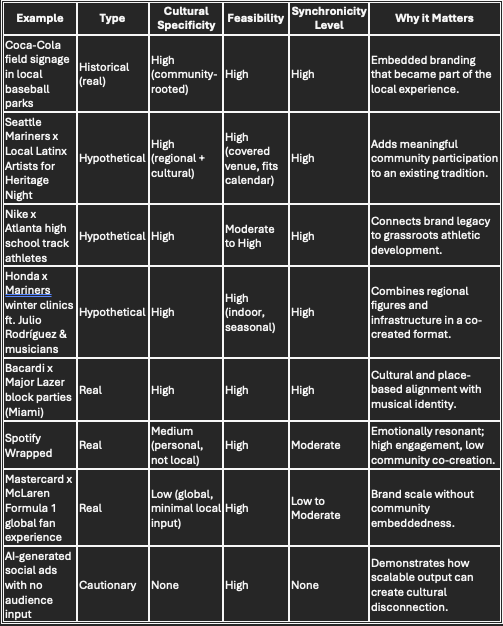
This isn’t nostalgia. It’s how marketing worked in the 20th century. Coca-Cola signs at local baseball fields weren’t just branding—they were part of the place. Brands used to create spaces for communities to form. It worked because there was intrinsic value to what the brands were offering, and that value aligned to the brand and the value proposition of the product. There are a lot of refreshments to be sold over 50 summers of baseball.
The Thesis: Brand Synchronicity
What is involved in this oppositional call, this concept of brand synchronicity?
Brand synchronicity happens when a brand’s marketing efforts reinforce, and are reinforced by, the voices, people, and cultures of a specific region, moment, and/or community. It’s not strictly sponsorship. It’s not strictly performance. It's not even specifically alignment, but it is participation.
It’s when a brand doesn’t just show up, but shows up in sync with the people and cultures that define the space it enters.
Rather than pumping out templated ads and generic partnerships, brand synchronicity requires:
Collaborating with local artists, musicians, athletes, and leaders
Supporting events and storytelling that invite the community to shape the moment
Providing infrastructure and investment, not just branding and ad space
Focusing on feasibility—ideas that are grounded, timely, and executable (e.g., don’t host outdoor clinics in Seattle in February)
"Iconic brands don't mimic existing culture, nor do they grab on to emerging trends. They are cultural." — Douglas Holt, How Brands Become Icons (Goodreads)
“A brand that captures your mind gains behavior. A brand that captures your heart gains commitment.” — Scott Talgo
The Matrix: Examples of Brand Synchronicity in Action
To help ground this concept and prepare the foundation for a practical framework, here’s a bi-directional matrix of brand synchronicity examples—real, hypothetical, and cautionary—hopefully showing up in your browser, email, or device better than the last time I tried to send a table.
The Framework: How to Practice Brand Synchronicity
Brand activism might take a stand—but cultural participation provides communities a seat at the table.
The difference matters. One broadcasts alignment. The other builds relationships. One is rooted in brand identity. The other is rooted in place, people, and reciprocity.
Brand Synchronicity isn’t about promoting your values. It’s about embedding your brand into the values already lived by a community—and helping strengthen the infrastructure that supports those values through collaboration, creativity, and continuity.
Brand synchronicity only works when all participants derive real value from participation. It's not just about a brand showing up—it's about everyone showing up, willingly and meaningfully. Each activation must offer utility to sponsors, athletes, musicians, artists, and the community alike. If participation increases value for one group but creates disincentives for another, the synchronicity breaks.
True synchronicity means letting go of full control. Brands must shape the space without trying to script the outcome. The goal is to set the conditions where community, creativity, and culture can unfold organically. Let cool happen in the cool place you helped create.
To turn this concept into a replicable approach, brands can use the following framework to evaluate and implement marketing efforts rooted in real community engagement. Each step builds on the principles of cultural specificity, feasibility, and additive alignment.
1. Anchor in Place
· Identify geographic and cultural zones of relevance.
· Research local customs, events, leaders, and artistic voices.
· Ask: Whose community are we entering? And why should we be here?
2. Listen and Learn First
· Engage local artists, athletes, and organizers not as vendors—but as collaborators.
· Conduct listening sessions, community audits, or informal salons to understand the needs and desires of the community.
· Ensure feedback loops are embedded from the start.
3. Co-Create the Moment
· Build activations that invite community participation, not just attendance.
· Co-design with community partners: musicians, creators, educators, and team players.
· Don’t just sponsor—help shape the thing itself.
Designing for emergence means building the conditions—not the content. The most resonant cultural moments aren’t manufactured; they arise when people interact freely within spaces shaped by intention, relevance, and care. Don’t force outcomes. Don’t over-control. Facilitate emergence. Let the moment belong to the people who create it.
4. Design for Continuity
· Avoid one-offs. Instead, create formats that can return, evolve, and grow (e.g., annual mural series, seasonal clinics, rotating showcases, ongoing relationships or workshops, etc).
· Explore modular event design that can adapt across neighborhoods or cities without becoming generic.
5. Fund Infrastructure, Not Just Impressions
· Provide value beyond the moment: equipment, studio time, space rental, transportation, amplification.
· Treat marketing budgets as community capital.
This isn’t charity—and it’s not philanthropy. It’s community capital. A brand’s marketing budget, when deployed with intention, can become infrastructure: funding space, time, tools, and amplification for creators, athletes, educators, and organizers. The ROI isn’t just reach—it’s relationship. It’s roots. It’s cultural longevity.
6. Filter for Feasibility
· Align with local climate, calendar, and context.
· Ask: Would this work here, in this season, with these people?
· Avoid blue-sky concepts that sound good on paper but die in production.
7. Measure What Matters
· Use mixed metrics: attendance, participation, press, brand sentiment, artist amplification, and long-tail cultural impact.
· Rely heavily on causal inference, and structure campaigns and programs to make holdout testing or measurement against matched market growth rates a central part of your game plan.
· Use marketing performance to justify future investment, not past vanity. It's a lift getting the initial program out the door, even if the funds come from corporate social responsibility budgets, but demonstrating real business impact is how you build a sustainable program or practice.
This isn’t just a playbook—it’s a provocation. What if your brand was part of the reason a neighborhood remembered a summer? What if your budget helped someone paint their first mural or play their first show?
That’s not just marketing. That’s legacy.
Signals from the Field
While the cultural logic of brand synchronicity may feel intuitive, there’s increasing evidence—qualitative and quantitative—that the market is moving in this direction. These aren’t just trends. They’re cracks in the current system and early signals of a shift in values, behaviors, and expectations.
1. Declining Feed Engagement—And What’s Surviving It
· Instagram engagement fell by over 30% across industries for the third consecutive year, while Facebook and X (formerly Twitter) also saw stagnating or declining metrics (Rival IQ, 2024).
· Contentgrip notes that while feed-based image content has cratered, engagement with TikTok and Reels remains stronger, suggesting that real people, real context, and video storytelling still hold attention (Contentgrip, 2024).
· Separately, commentary and data from creators and marketers suggest that YouTube has remained durable during this same period—particularly through context-rich creators and parasocial storytelling. This supports the broader pattern: engagement is shifting toward formats rooted in meaning, personality, and human presence, not automation or algorithmic filler.
The takeaway? Users haven’t disappeared—they’ve followed authenticity into new formats. Synthetic content underperforms not just because of what it is, but because of what it lacks: stakes, specificity, and shared presence.
2. Creator-Led Platforms & Direct Community Building
· Patreon reports that it hosts over 300,000 creators and more than 10 million fans paying for memberships each month, reflecting a strong consumer desire for deeper, community-based experiences (Patreon).
· Substack has doubled down on its "reader communities" feature to let writers build owned audiences that feel more like clubs than broadcasts (Axios, 2023).
3. Brands Investing in Cultural Participation
· Bacardi’s "Music Liberates Music" initiative has funded Caribbean musicians and partnered with Major Lazer to spotlight local genres (Partnership Movement, 2022).
· Jordan brand’s $100 million, 10-year commitment to racial equity has already distributed over $8 million to 37 grassroots organizations through its Community Grants Program, including those advancing economic justice and leadership development (Nike, 2024).
· The San Francisco Giants’ annual Fiesta Gigantes event celebrates Hispanic culture by featuring local artists, musicians, and community organizations at Oracle Park, exemplifying how MLB teams are incorporating cultural outreach and community participation into their brand presence (MLB.com).
4. Backlash to AI Slop
· A wave of criticism has emerged against the proliferation of AI-generated "slop content"—poor-quality, filler-style media. The Week and Futurism have documented the rise of AI junk sites and the degradation of web search experiences (TheWeek, 2025).
· The Atlantic published articles regularly about how AI is killing the internet, destroying the great public good of the web, and disconnecting humans in the digital space from the very authentic information, experiences, and interconnectivity that made it valuable(The Atlantic, 2024).
5. Emerging Brand Behaviors That Prioritize Alignment
· Converse’s "All Stars" community program supports young creatives around the world with funding and exposure, with a goal to co-create—not simply market (Converse.com).
· Spotify’s partnership with GLOW, a playlist highlighting LGBTQ+ artists, leverages its platform for identity-based community building rather than mass reach alone (Advocate, 2023).
· Localized activations like mural festivals (e.g., POW! WOW! Worldwide, now known as Worldwide Walls) show that brands can integrate seamlessly into grassroots events—when done respectfully and intentionally.
Here are the receipts. These are not edge cases. They’re a signal. They’re THE signal.
People want to belong. People do not want to be targeted.
The Invitation
Synchronicity isn’t a soft ideal—it’s a strategic response to an attention economy in decline. It’s a way to build trust, earn loyalty, and grow through relevance, not repetition.
If your brand is serious about long-term value, it needs to become part of the communities it hopes to serve—not just interrupt them.
And it’s not just an invitation. It’s a warning.
When brands make promises of belonging, of roots, of cultural commitment—they must follow through. The Oakland Athletics once ran a campaign called Rooted in Oakland. But as ownership attempted to relocate the team, fans responded with heartbreak and fury. They showed up to games with protest shirts and flags. They demanded the team be sold. The brand’s betrayal wasn’t just logistical—it was emotional. That campaign backfired because the brand claimed place without investing in it.
The lesson? When brands borrow meaning from communities, they owe something in return. When they extract without giving, the backlash is cultural. Real communities remember who showed up—and who left.
The good news? There are already people doing the work. Partner with them. Fund them. Follow their lead.
That’s the work. That’s the way forward.
Why This Matters Now
Distributed media is saturated. RoAS-driven tactics are cannibalizing themselves. The major platforms are bleeding trust and engagement, and yet, brands still need growth. They still need loyalty. They still need connection.
We have greater capacity now to measure whether what we invest in generates the kinds of outcomes we are seeking, and brand synchronization aligns well with measurement tools like causal inference testing because it is already selective in terms of population holdouts.
The answer isn’t better ads. It’s better alignment. Not just with brand values—but with real people. In real places. Creating real culture. Together.
That’s how you become part of something. That’s how marketing becomes valuable again.
That’s brand synchronicity.